TL;DR
The developer hiring market has shifted. Most organizations now use AI in recruitment, most developers use AI coding tools daily. Companies recruit "AI orchestrators" rather than pure coders. Team sizes at successful startups have shrunk. Entry-level hiring has collapsed while demand for senior AI-skilled developers remains intense.
What works now: skills-based hiring over credentials, global talent sourcing, compressed interview cycles, and practical assessments that evaluate AI-assisted problem solving. Give candidates a small project, with AI tools, delivering a working solution takes hours rather than days, making this a reasonable ask that reveals generalist capability.
The hiring playbook from 2024 has stopped working
The rules appear to have changed. Both sides of the hiring equation now operate on assumptions that did not exist two years ago.
Companies have shifted from seeking "code writers" to recruiting what might be called "AI orchestrators." The teams succeeding tend to be smaller than expected. A bifurcation has emerged: severe shortages for senior AI-skilled developers alongside a notable decline in entry-level hiring.
As Peter Drucker observed: "The greatest danger in times of turbulence is not the turbulence, it is to act with yesterday's logic."
AI has changed both sides of the table
AI now handles initial screening at many companies. Chatbots manage first-round candidate communication. Time-to-hire has compressed at organizations using these tools.
On the candidate side, developers use AI tools as naturally as version control. Claude Code, Cursor, and similar tools have become standard equipment. Candidates learn new technologies faster. Cross-stack work requires less effort.
The developers who stand out treat AI as a junior teammate requiring supervision, they know when to trust it and when to verify.
The skills that matter have shifted
Verification appears to have replaced implementation as the primary value driver.
The priorities have shifted. Syntax mastery mattered before, critical thinking in code validation matters now. Algorithm memorization was tested, systems design and architecture get tested now. Single-language expertise was valuable, business context translation has become more useful.
One CTO summarized it: "We used to hire people who could code, now we hire people who can think, then use AI to code their thoughts."
Research from GitHub identifies three skill layers that seem to separate effective developers: understanding the work (AI fluency, technical fundamentals, product thinking), directing the work (delegation, orchestration, architecture), and verifying the work (reviews, security, assumption validation).
Many developers now spend more time verifying AI output than generating code themselves.
Rethinking the interview process
Traditional assessments have become less informative. LeetCode challenges made sense when syntax mastery mattered. Whiteboard coding tested skills that AI now handles.
A more effective approach: give candidates AI-generated code with subtle flaws and ask them to identify issues, explain the problems, and refactor the solution.
Better still, consider assigning a small practical project. With AI-assisted development, what once took days now takes hours. A candidate can build a working feature, fix a bug in a sample codebase, or create a small tool in an afternoon. This is no longer an unreasonable ask.
Such projects reveal generalist capability, AI tool proficiency, and the ability to deliver outcomes. They show how candidates approach ambiguity, make trade-offs, and communicate their decisions. The time investment has collapsed enough that this screening method has become practical for both sides.
The junior developer squeeze
Entry-level developer hiring has declined sharply. Employment among younger developers has fallen. A smaller fraction of new hires at major tech companies are recent graduates. Internship postings have dropped.
The pattern makes sense: AI now handles the tasks that traditionally onboarded junior developers. Writing boilerplate code, simple CRUD endpoints, basic bug fixes, unit test generation, documentation. The grunt work that taught previous generations has been automated.
The path of "learn by doing grunt work" has largely disappeared. Entry-level positions now require skill levels that used to be mid-level expectations.
Generalists have become the preferred hire
AI tools enable cross-stack work. Economic pressure demands more output with fewer people. The generalist developer has become the preferred profile.
Startups increasingly hire full-stack developers as their first tech hire. The friction of working across technologies has collapsed with AI assistance. One developer described creating a Figma plugin in a language they barely knew "in just two days" using LLMs.
As Robert Heinlein wrote: "A human being should be able to change a diaper, plan an invasion, butcher a hog, conn a ship, design a building, write a sonnet, balance accounts, build a wall, set a bone, comfort the dying, take orders, give orders, cooperate, act alone, solve equations, analyze a new problem, pitch manure, program a computer, cook a tasty meal, fight efficiently, die gallantly. Specialization is for insects."
The most valuable developers combine technical engineering skills with product management perspective, design thinking, and business strategy understanding. "I just write the code" has become a limiting statement.
Small teams are achieving surprising scale
The team sizes at successful companies have surprised observers. Companies like Midjourney and Cursor have achieved remarkable revenue with teams smaller than what conventional wisdom would suggest necessary.
A single AI-savvy engineer can accomplish what used to require multiple traditional coders. Startups increasingly seek one exceptional AI-augmented generalist rather than three specialists.
AI agents are starting to implement tickets
The developer role has evolved from implementer to reviewer and orchestrator.
Tools like Cursor now offer Background Agents that execute tasks independently. Devin AI works through Slack with access to code editor, terminal, and browser. Large financial institutions have deployed such tools alongside their human developers.
The reality check matters here. Most AI-suggested code still gets rejected. Few developers highly trust AI output. Nearly half actively distrust its accuracy. Human review remains dominant.
One study found experienced developers were actually slower with AI tools on familiar codebases, even though they believed they were faster. Developers remember spectacular AI successes and forget hours of unsuccessful attempts.
Challenges in the current market
The skills gap paradox presents difficulties. Most companies experience skills gaps. Most developers use AI tools. Distinguishing candidates who effectively leverage AI from those dependent on it requires new evaluation methods.
Time pressure has intensified. Candidates expect two to three interview stages maximum, completed within two weeks. Missing that window often means losing candidates to faster competitors.
Application volume has increased. Remote positions attract more applicants. AI tools help candidates mass-apply, flooding pipelines.
Strategies that appear to work
Skills-based hiring has gained traction over credential requirements. The focus shifts to what candidates can demonstrably do, how they approach problems, and their ability to learn and adapt.
Global talent sourcing has expanded. Hiring globally for remote positions expands the talent pool significantly.
Speed has become strategic. Limiting to two or three interview stages, aiming for decisions within two weeks, automating administrative tasks, and pre-scheduling interviews in blocks all help.
Relationship management beats constant sourcing. Managing relationships with known talent produces better results than perpetually searching for new candidates.
What developers appear to want
Remote work ranks above pay as the top factor in job applications for many candidates. Flexibility has become important for attracting strong talent.
Job satisfaction deserves attention. Many developers report dissatisfaction. Some indicate AI is "hollowing out" the enjoyable parts of their work. Developers who enjoy their work stay longer.
Finding developers in this landscape
The hiring landscape has changed. One constant remains: capable developers tend to show their work.
GitHub profiles reveal how developers use AI tools in their commits, their ability to review and refactor AI-generated code, contribution patterns that distinguish active builders from passive users, and cross-stack capability across multiple languages.
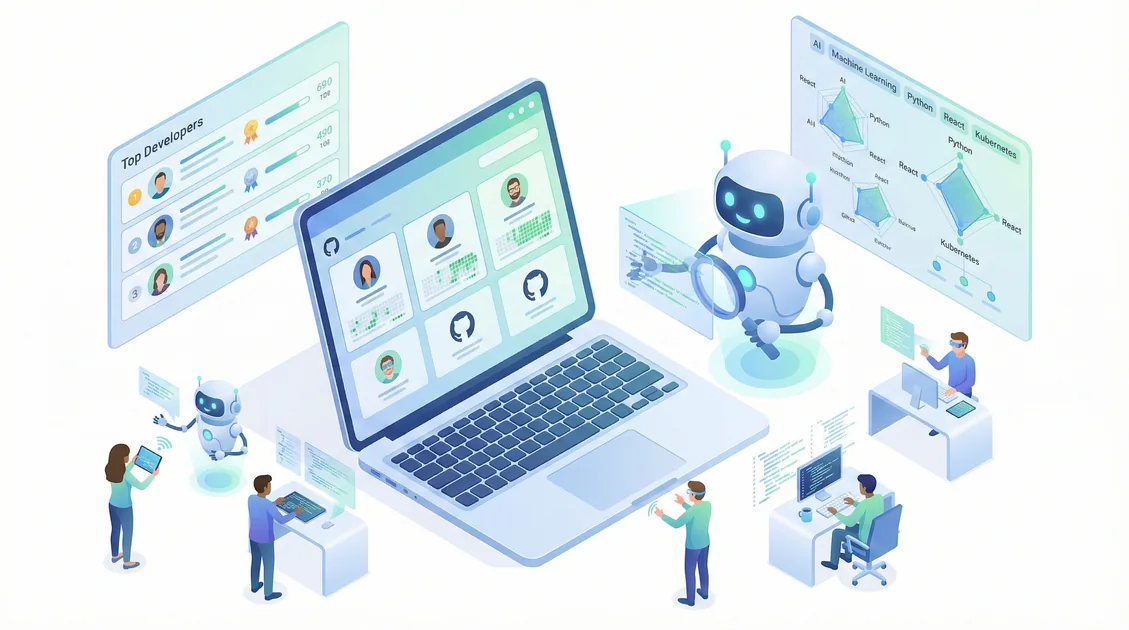
GitHunt was built to accelerate this discovery through location-based search, tech stack scoring, and activity ranking. Manual GitHub sourcing takes considerable time. Automated tools compress this significantly.
To help you find these AI orchestrators, GitHunt now includes a dedicated AI Orchestrator role in its search filters. This role prioritizes developers who demonstrate AI tool proficiency, code review skills, and the ability to work across multiple technologies.
Key takeaways
Hire AI orchestrators. Evaluate how candidates work with AI, not just whether they can code without it.
Test verification skills. Debugging and improving AI-generated code has become the assessment that matters.
Assign practical projects. With AI tools, candidates can deliver working solutions in hours. This reasonable ask reveals generalist capability and real-world problem solving.
Prioritize generalists. Full-stack capability enabled by AI tools provides more value than deep specialization in most contexts.
Move fast. Complete hiring cycles in two to three weeks. Slower processes lose candidates to competitors.
Go global. Remote work expands the talent pool substantially.
Adjust junior expectations. Entry-level now requires what mid-level used to require. Plan training programs accordingly.
Look for product thinking. Engineers who own outcomes rather than just completing tickets command premiums.
The developers who thrive combine AI efficiency with human judgment. Finding them means building teams that accomplish what used to require much larger headcount. The patterns continue to shift, these observations will likely need updating as the market evolves.